Every winter, roughly half of the North Pacific’s humpback whales leave their feeding grounds in the far north and swim to the warm, shallow waters around Hawaiʻi to mate, give birth and raise their calves. Hawaiians call them koholā. From Unit 1903’s lanai, which looks due west over open ocean with the surf 20 feet below, you can often watch them without leaving your coffee.
When to come
The Humpback Calendar
- October: out of season
- November: arriving or leaving
- December: in season
- January: peak season, with a Sanctuary Ocean Count on the last Saturday
- February: peak season, with a Sanctuary Ocean Count on the last Saturday
- March: peak season, with a Sanctuary Ocean Count on the last Saturday
- April: in season
- May: arriving or leaving
- June: out of season
NOAA’s humpback sanctuary puts the season at November through April, with the most whales from January through March. A few linger into May, and the odd whale turns up in other months, but for the best odds, plan a whale trip for midwinter.
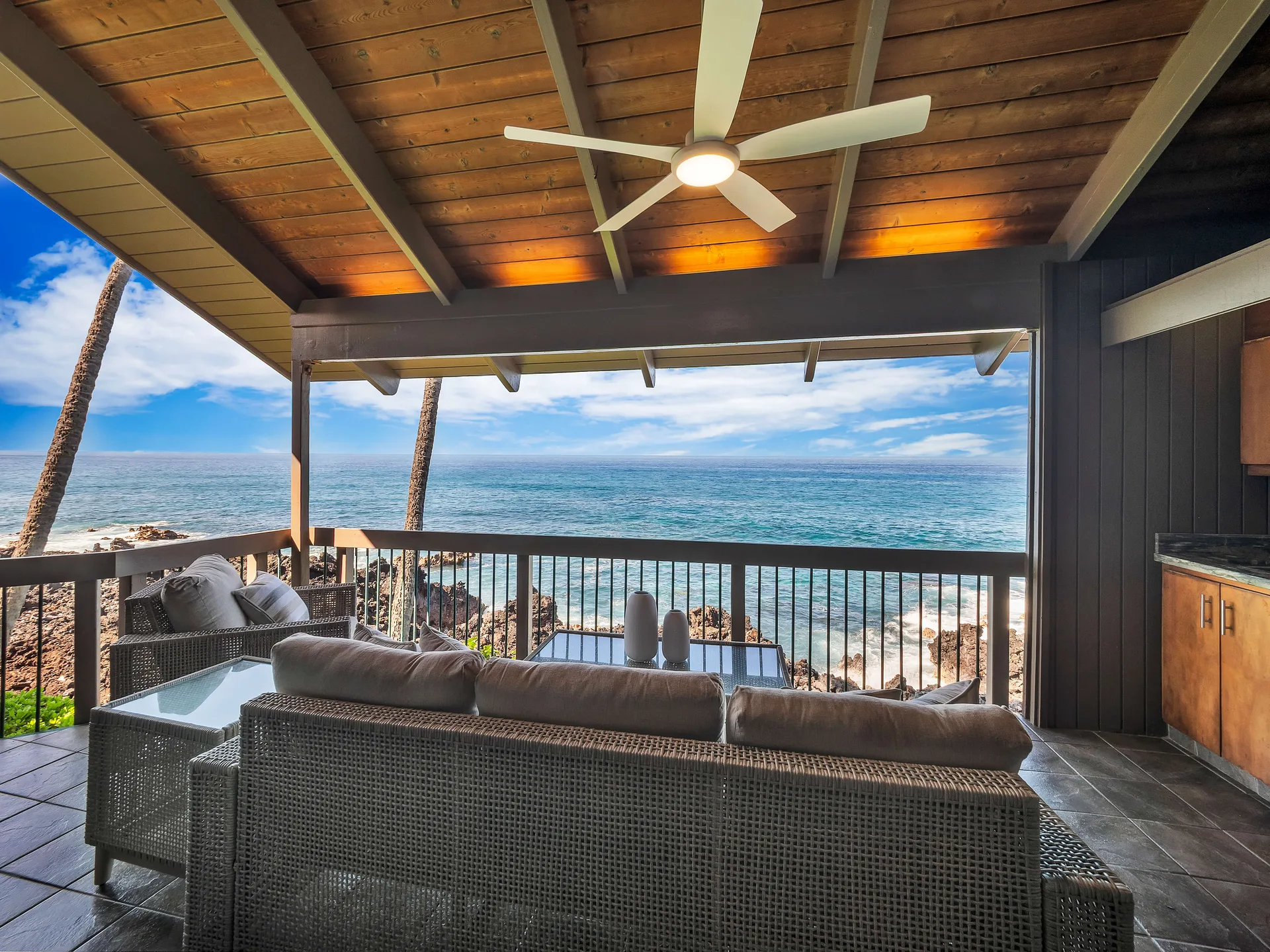
From the lanai
A Front-Row Seat
The penthouse’s main level is raised above the shoreline, so the lanai looks over the surf to an unbroken horizon. In season, that horizon is where the spouts appear. Whales are wild, though: some mornings the water is busy with them, and some days it stays quiet.
- 269°
- The lanai’s bearing: due west, straight out to sea
- 20 ft
- From the lanai to the surf
- Jan–Mar
- The peak months for humpbacks in Hawaiʻi
Reading the water
What to Look For
- 01
The blow
A puff of white mist on the horizon is usually the first sign. When you see one, keep watching the same patch of water: a whale near the surface often blows several times before it dives.
- 02
The breach
A whale launching most of its body out of the water and landing with a huge splash. The splash is visible from miles away, even when the whale itself is just a dark shape.
- 03
Tails and fins
A raised tail fluke usually means a deep dive, so expect a few minutes before it reappears. Repeated splashes in one spot are often a whale slapping its tail or long pectoral fins on the surface.
Tip Bring binoculars, and scan slowly from left to right rather than staring at one spot. Calm water with few whitecaps makes blows much easier to pick out.
On the water
Whale-Watch Cruises
For a closer look, these Kona operators run dedicated whale-watching trips in season. Body Glove departs from Kailua-Kona, about 20 minutes’ drive north of Kanaloa. Schedules and prices change every season, so check before you book.
Body Glove Whale Watch
Body Glove Cruises- 2.5 hours
- Catamaran
- Afternoons
A relaxed afternoon on a big catamaran with a naturalist narrating. They drop a hydrophone over the side, so you may hear the males singing as well as see them. There’s a chance of spinner dolphins and sea turtles too.
Schedule & bookingSuper-Raft Whale Watching
Body Glove Cruises- 2.5 hours
- 41-ft raft
- Ages 6+
A faster, lower boat that leaves from Kailua Pier, with shade, padded seats and a restroom on board. It’s a bouncier ride, so it isn’t for young children, pregnant guests or anyone with back or neck trouble.
Schedule & bookingCaptain Dan McSweeney’s Whale Watch
- 3 hours
- Researcher-led
- Tue · Thu · Sat
Dan McSweeney is a whale researcher who has run whale-watching trips off Kona for close to four decades. Departures are limited and change by month, so check his schedule before you plan around one.
Schedule & bookingGive them room
The 100-Yard Rule
Humpbacks in Hawaiʻi are protected by federal law and by the Hawaiian Islands Humpback Whale National Marine Sanctuary. It is illegal to approach within 100 yards of a humpback whale, and that applies whether you’re in a boat, on a kayak or paddleboard, or swimming. If a whale comes toward you, stay calm and slowly back away, or put the engine in neutral until it moves on.
- Entangled or injured whale (888) 256-9840
- Report a close approach (800) 853-1964
Join in
Sanctuary Ocean Count
On the last Saturday of January, February and March, the sanctuary runs a shore-based whale count from sites on Hawaiʻi Island, Oʻahu and Kauaʻi, from 8:00 a.m. to 12:15 p.m. Volunteers, visitors included, log every whale they see. Registration is at oceancount.org.
Spend Whale Season at Kanaloa 1903
Three bedrooms, sleeps eight, and an oceanfront lanai facing the whales’ winter waters.